10 Truths Your INFJ Needs You to Know
INFJs rarely tell you what they need.
Not because they don’t know, but because what they carry is often difficult to translate. Much of their inner world exists beneath language, beneath immediacy, beneath what can be easily pointed to or proven.
INFJs don’t stop being INFJs when they grow up.
Many of the patterns that shape an INFJ adult, like their sensitivity, depth, intuition, and inner complexity, were already present in childhood. They were simply less articulated, less protected, and often less understood.
The truths shared here emerged originally from reflections on INFJ children, particularly within family systems. But they apply just as strongly to INFJ adult relationships, workplaces, friendships, and communities.
Whether you are a parent raising an INFJ child, or someone trying to understand the INFJ adult in your life (or yourself), these truths are not instructions. They are orientations, ways of seeing that make relationships less confusing, less strained, and more humane for everyone involved.
1. INFJs are rare, and they experience the world differently
INFJs are rare, but rarity is not the point. What matters is how they experience life.
Their attention is drawn not to what is obvious, but to what is forming underneath like patterns, meanings, contradictions, future implications. This way of perceiving is intuitive and inward, and it often operates long before the INFJ can explain what they are sensing.
They are not trying to be difficult, they are responding to a deeper layer of reality.
2. There is far more going on inside them than you can see
Many INFJs learn early in childhood that their inner world is hard to explain and harder to receive. As a result, they may become quiet, not because they have nothing to say, but because sharing feels effortful or unsafe.
Later, as adults, this can look like emotional self-containment or distance, when in reality the inner world has never stopped moving.
Given the right question, the right moment, and genuine curiosity, INFJs can speak at great depth.
You don’t need to fully grasp everything they’re saying, you just need to show that it’s welcome.
3. They may understand others’ feelings better than their own
INFJs are highly attuned to the emotional states of others. Often, they can read the room more accurately than the people in it.
The difficulty is that this sensitivity can blur emotional boundaries. An INFJ may feel anxiety, sadness, or tension without knowing whether it belongs to them or someone else.
Helping an INFJ slow down and ask, “What am I feeling…what am I picking up?” is grounding, not indulgent.
Clarity here prevents unnecessary guilt and emotional overload.
4. Don’t hide your feelings from them, they’ll sense it anyway
INFJs sense emotional undercurrents whether they are spoken or not. When something is clearly felt but verbally denied, it creates internal dissonance.
You don’t need to over-share or explain everything. Simply acknowledging your emotional state, for example “I’m a bit off today”, often reduces their anxiety rather than increasing it.
For INFJs, unspoken emotions are louder than spoken ones.
5. They are not your counsellor
INFJs often appear mature, insightful, and emotionally perceptive, even as children. Because of this, they can be unintentionally placed in roles they are not ready for.
As adults, this pattern can continue, with INFJs becoming emotional containers for others without realising how much they’re carrying.
Understanding deep things does not mean being equipped to hold them.
Boundaries are not rejection, they are care.
6. Harmony is a need, not a preference
INFJs are often deeply attuned to the emotional atmosphere around them. As children, this may show up as anxiety, withdrawal, or quiet watchfulness. As adults, it may look like conflict avoidance or emotional fatigue.
Unresolved tension is especially difficult for INFJs, because they carry it internally long after others have moved on.
Gentle check-ins matter:
How are you feeling about what’s been happening?
Did anything feel heavy for you today?
This creates space for release rather than accumulation.
7. Don’t be afraid to be wrong
INFJs can be unnervingly perceptive. Sometimes they see what others don’t, and sometimes they name it.
When someone they trust admits fault or acknowledges a misstep, it doesn’t weaken the relationship, it strengthens it.
Denial erodes trust. Honest humility builds it.
8. Be gentle, INFJs are often already hard on themselves
In childhood, INFJs are vulnerable to internalising mistakes quickly and deeply. By the time correction arrives from outside, it has often already occurred within.
For the INFJ, gentle guidance and collaboration works better than confrontation.
Growth, for INFJs, comes through understanding.
9. Pay attention to their hunches
INFJs may express insights that seem to appear from nowhere. In childhood, these intuitive leaps aren’t always accurate (initially), but they are meaningful.
What matters first is expression, not correctness.
By allowing hunches to be voiced, you help INFJs develop confidence in articulating their inner perceptions. Accuracy follows articulation, not the other way around.
10. Don’t idealise them
INFJs can either feel invisible or overly seen.
Being placed on a pedestal can be just as disorienting as being misunderstood. INFJs are not meant to be symbols, saviours, or emotional anchors.
INFJs need room to fail, rest, and grow.
Bonus Truth: Truth is what centres an INFJ
INFJs have a deep relationship with truth.
When truth is welcomed, spoken carefully, and lived consistently, INFJs tend to feel grounded and safe. When truth is distorted, denied, or avoided, they often feel unsettled without knowing why.
Truth aligns their inner world, and allows them to relax into themselves.
Closing reflection
This isn’t about managing an INFJ, it’s about meeting one.
When an INFJ feels seen without being criticised, heard without being used, and intellectually held without being controlled, something quiet but profound happens.
They come home to themselves — and invite you into that space with them.
I’m Scott Morgan, a counsellor and certified MBTI® practitioner. I offer online counselling for individuals and couples, including INFJs wanting to explore identity, relationships, purpose, life direction and personal growth. You can learn more about my counselling services or make an enquiry.
Continue exploring INFJ intuition and purpose
If you found this article helpful, continue with INFJ – Supercharging Introverted Intuition (Ni), where I explore how INFJs can better understand, develop and work with their dominant intuitive function.
You may also enjoy The Consciously Unconscious INFJ — an exploration of the largely unconscious inner processing that shapes how INFJs perceive themselves, other people and the world around them.
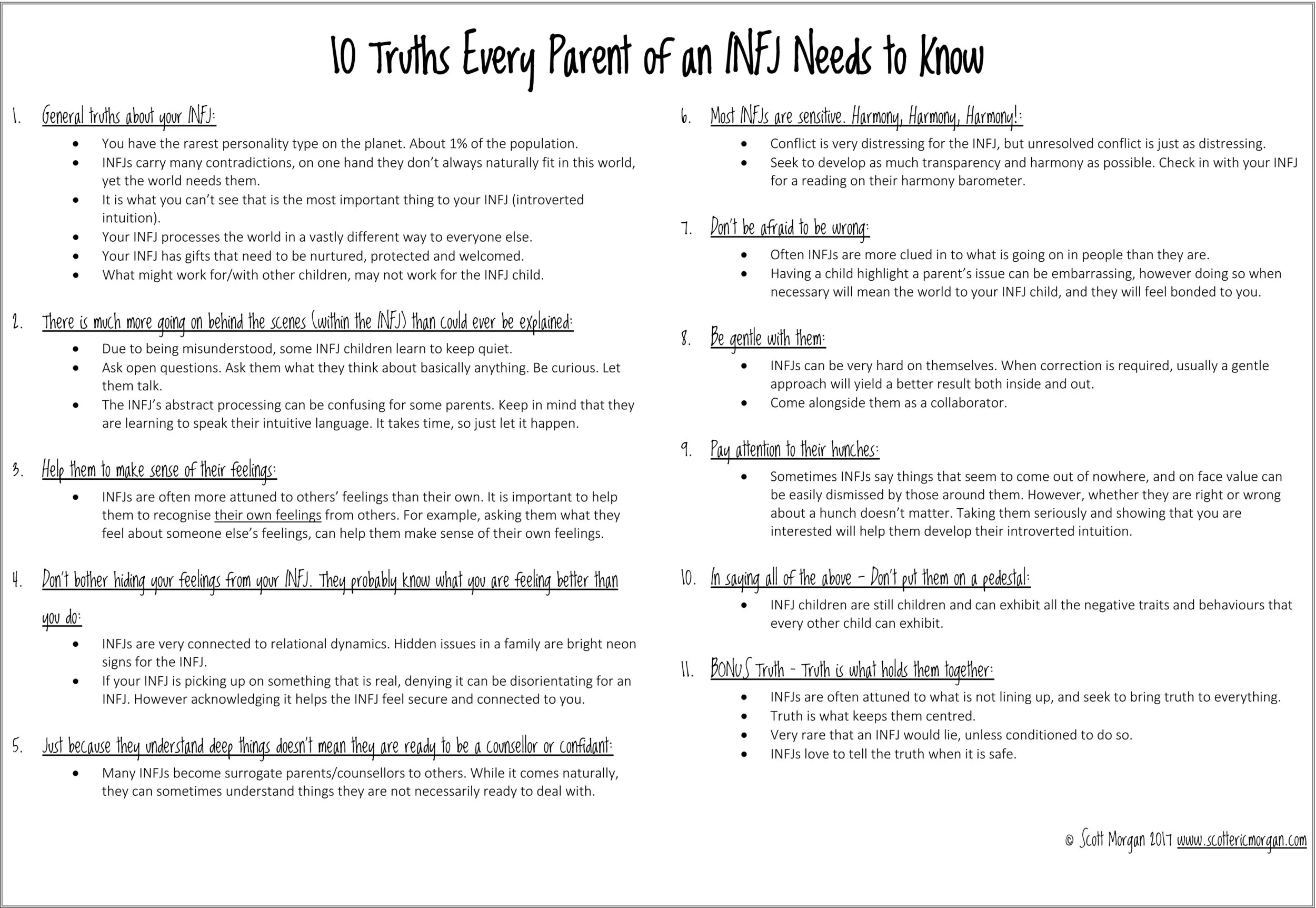
Click the image to view full size or download
Click to watch the supporting video on this topic